
Burrowing practice
materiality, hyperobjects and writing

Tomorrow I’m off to Manchester Poetry Library to read with Isabel Galleymore as part of a curated series organised and hosted by Helen Mort . I’m a big admirer of Isabel’s and am so interested in her work on cuteness, so it’ll be great to talk about the ‘significant other[s]’/ more-than-human in our poetry. If you’re in the area, come along.1
In preparation for the event I’ve been thinking about what I want to read. I often begin my readings by recounting my first conscious meeting with the northern lapwing. It is a story of walking. In particular, walking with a young baby strapped to my chest. Walking with no fixed destination except time and space and my daughter’s (and my) rest. Walking to stay close to home and get lost from home and walking as already lost and deranged before I’d even left the house. I was also walking in a new way. Slower, heavier, with my arms scooped across my front to support the extra bundle, and bobbing, in that particular way that you do when you’re holding something that you want to get to sleep. And it was like that, plodding, and bobbing, and walking with no destination that I first saw lapwings across the field.
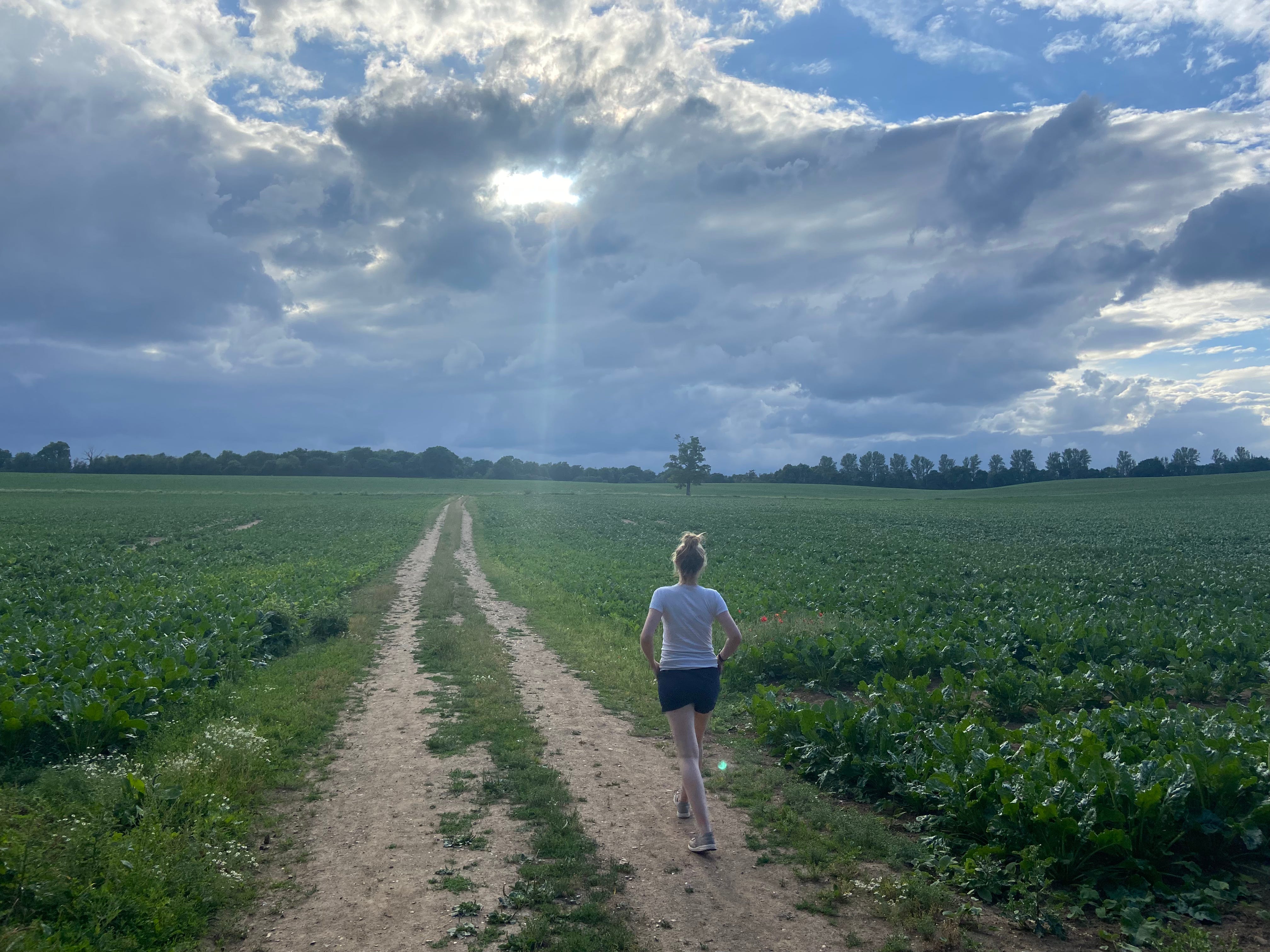
Walking while heavily pregnant a few years- a different kind of bobbing slowness
I’ve always thought that I delivered that story for the sake of the audience. It provides a way in the collection and provides a human face to the sequence. I’ve never really considered the materiality of this moment until recently - about the real truth of it. About how if I hadn’t been walking as slowly, if I hadn’t had been bobbing up and down in that very particular practiced movement, and if I hadn’t been thinking about caregiving and feeling exhausted and generally a bit run through then I probably wouldn’t have spotted the lapwing that I spotted in a field that I’d walked and run through a hundred times before. I’ve no doubt that lapwings had been returning to nest there for years. But I’d never seen them. That day, it was the particular material conditions that I was bringing to that field that gave me a new way of noticing, and a bodily awareness of my position as just another creature in a field.
In some ways it was the first time I’d been fully grounded in that space. Less vertical, more vulnerable, my body moving differently, my mind more open to being lost. In short, I was learning in a place, rather than of a place.
Back in 2013, Timothy Morton wrote about ‘hyperobjects’. Hyperobjects is a term, according to Morton for ‘things that are massively distributed in time and space relative to humans’. They can be natural or man-made, manufactured by humans or otherwise. They have a variety of characteristics in common:
They are viscous, which means they “stick” to beings that are involved with them. They are non-local; in other words, any “local manifestations” of a hyper object is not directly the hyperobject - it’s just a small glimpse of it through our limited human perspective. They involve profoundly different temporalities than the human-scale ones that we are used to [which means they can be invisible to humans for large stretches of time]…and they exhibit their effects interobjectively; that is, they can be detected in a space that consists of interrelationships between aesthetic properties of objects. So basically, hyperobjects are not figments of our imagination. They are not the product of our knowledge. They do not depend on our knowledge. They are real whether we think of them or not. Their ‘hyperness’ is not just because they are hyper to our understanding, or how much power or emphasis we give them, or how much we acknowledge their significance. They are equally relative to worms, lemons, and ultraviolet rays , as well as humans.2
But it is that relativity and viscosity and non-localness that makes writing about the environment and global warming so difficult. We can assert, for instance, that global warming exists. Then someone might ask where global warming exists. We can point to a spate of wildfires, a recent landslide, rising sea temperatures, the death of the coral reef. But they are all local glimpses of places where global warming has felt sticky to us. We still can’t conceptualise the whole of it, and we are still vulnerable to someone pointing out a one-off cold spell as evidence to the contrary. Equally, when we try and understand an oil spill, or visualise all the microplastics that exist in the world, or try to visualise and write about all the clothes and fabric that will exist and can exist and all the rubbish we have ever created, it becomes easy to feel overwhelmed and unmoored and abstracted in the face of all that hyperness.
For the past year I’ve found it incredibly challenging to find a way in to writing poetry in the face of this conceptual abstraction. Before, I would have headed to an archive to break the slump. I’m someone who’s always enjoyed working with archives - the type that are acquired, catalogued, stored and requested. In the past they’ve allowed me to ‘ground’ myself in my work. Even closer to home, I love a junk drawer, the life stuffed together in an organising principle that makes no sense except to the person doing the collecting (I’m thinking of my papa here - the master collector, the king of the junk drawer). But this materiality - the particular fever, the dust transferred onto clothes and skin - is different when the archive is also organic, unfixed, changing everyday, everywhere.3 The whole traditional notion of an archive is different, even redundant in the face of environmental memory and future. The archive - as a housed collection in a location that demands identification and membership - sometimes feels attached to a human history bound up in extraction - in visiting, removing, collecting, labelling and assigning meaning. It is all about materiality, yes, but the kind that seems centred on discovery and revelation rather than immersion and learning ‘in’ rather than learning ‘of’. I want the collective (not collected), activist space of the archive as ongoing and unenclosed. I want to ground myself in with the subjects I care about, not extract from them.
Maybe I’m just looking for the next origin story. Right now everything is too big, too hyper, to locate.
Perhaps then I need to centre this grounding; I need to think of it as an ongoing verb. As an act of humility, as a willingness to be led by and to the field, whatever and wherever it may be, as an openness to the material conditions of yourself and your field.
In their book, Fieldwork for Future Ecologies, editors Bridget Crone, Sam Nightingale & Polly Stanton call for the creative practice of ‘burrowing’:
Imagine you are making a burrow: the direction, the depth and width of your burrow depend on the conditions of the ground (its texture, relative moisture, elevation, mineral consistency and so on); as you move, you do not know where you might end up and gradually your orientation and sense of space relative to the above ground world changes … a burrow unfolds according to the ground within which it is established, as such it is implicated within that ground becoming through and conditioned by particularities of geology, terrain, water tables, incline and other lives lived in relation.4
I love the openness of this - the fact that a poetic process must be determined by the ground. Burrowing into bog unfolds differently to burrowing into ice and the very act of being a poet in that space must adapt accordingly. I love the hope too. It feels suddenly more possible to find a way into the ‘hyper’ stuff if the way in is as important as the stuff itself.
All this is to say that I wasn’t writing but now I am trying again.
It’s almost the solstice. I am almost in mourning for light again. And I am thinking about hyperobjects and archives and plastic and all the fabric that’s ever been produced in the world and ever will be produced and all the beaches it tangles together on to form a new shoreline. And I’m also thinking about poetry, the woods, soil, fields, the air, the wasteland, the motorway, the recycling centre, the beach and all the other sonorous spaces.
Previous events in Helen’s excellent series are available to watch online. Here’s her chat with Roy McFarlane:
Timothy Morton, Hyperobjects: Philosophy and Ecology After the End of the World’, Uni of Minnesota Press: Minneapolis and London, 2013, pp.1-2.
For a brilliant book on archives and archival research and creativity, see Caroline Steadman’s Dust, Manchester Uni Press, 2002.
Fieldwork for Future Ecologies: Radical Practice for Art and Art-based Research, eds. Bridget Crone, Sam Nightingale & Polly Stanton, (Onomatopee Projects, Eindhoven, 2024), p.10.
Beautiful post. I love 'a burrow unfolds according to the ground within which it is established'!